
Why Great Institutions Invest in Public Art
When people enter a railway station, university campus or public building, they begin forming an impression before anyone speaks to them.
They notice the entrance. They notice the walls, the scale of the space, the light and the objects around them. They sense whether the place feels welcoming, memorable or connected to its surroundings.
Most institutions understand the importance of architecture, signage and landscaping. But some go further. They use art to give the place a character of its own.
This is why great institutions invest in public art.
Not simply to fill an empty wall or decorate an entrance, but to tell people where they are, what the place represents and why it matters.
A building provides space. Art gives it meaning.
Every institution has a story.
A university may stand for knowledge and aspiration. A company may value innovation and teamwork. A railway station may be the first introduction a traveller receives to an entire region.
These values are usually written in brochures and vision statements. But most visitors never read them. They understand an institution through what they encounter there.
Public art can make those ideas visible.
A sculpture, mural or installation can carry history, culture, ambition and memory without turning them into an advertisement. It allows people to discover meaning through the experience of the place itself.
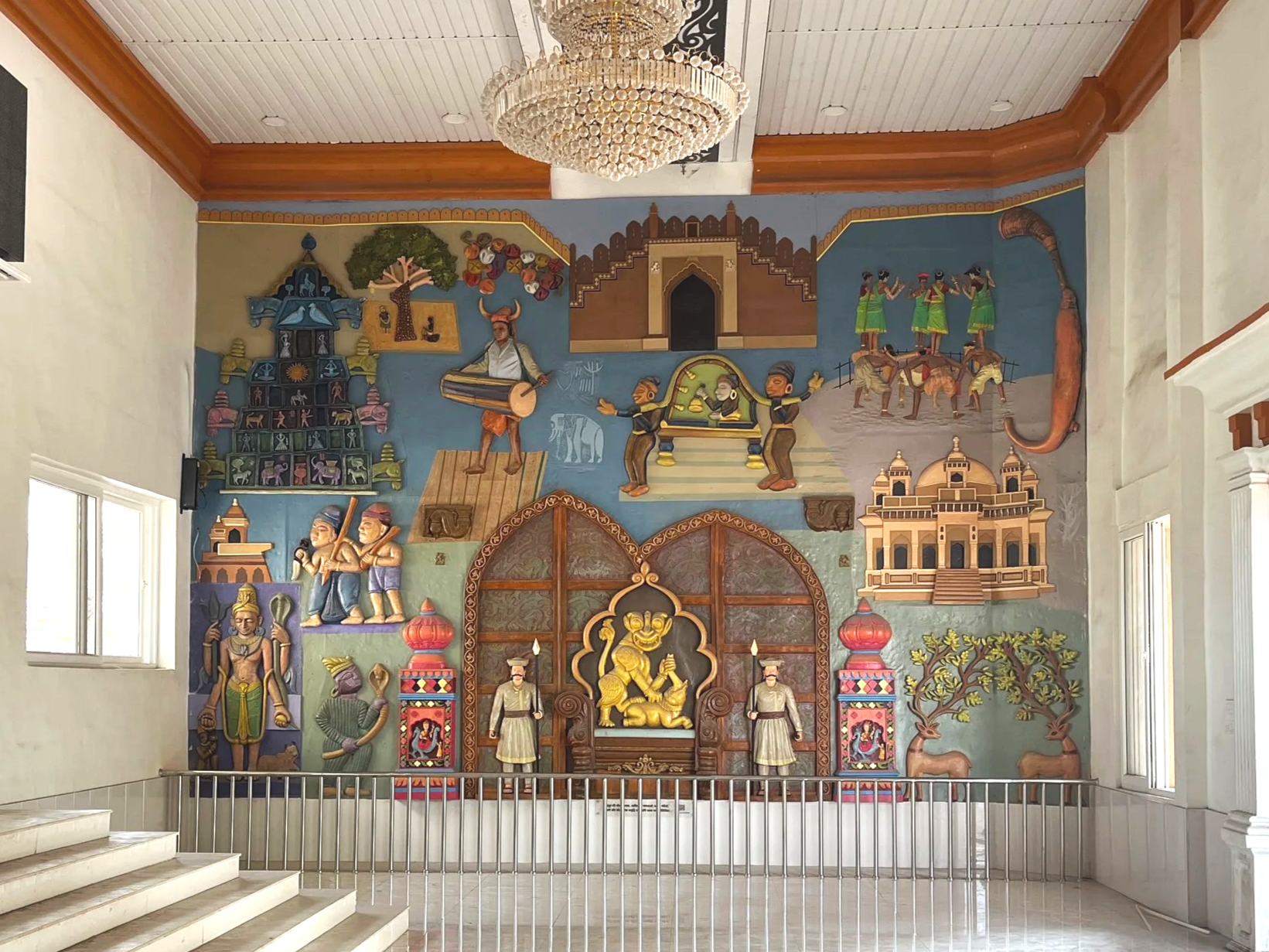
We saw this clearly while working at Chanda Fort Railway Station.
Before beginning the artwork, we visited the site, studied its architecture and interacted with local people. We looked at the history of Chandrapur, the Gond dynasty, Adivasi culture, forests, wildlife, temples and the region’s coal-mining economy.
The challenge was not a lack of material. Chandrapur has many stories.
The real challenge was deciding what belonged at the station and how these stories could come together without turning the wall into a textbook.
The final mural covers two walls, each measuring approximately 18.3 by 27 feet. It brings several parts of the region into one visual field, including Gond history, Adivasi traditions, forests, tigers, temples, musical instruments and coal mines.
These subjects may appear different, but together they describe Chandrapur. The mural connects the region’s cultural memory, natural environment and working life.
A traveller may not understand every reference during the first viewing. But the scale and imagery invite another look. A local person may recognise a musical instrument, a pattern, an animal or a part of the region’s history. A visitor may become curious about a place previously known only as a name on a railway ticket.
That curiosity is valuable.
The station is no longer only a point of arrival and departure. It becomes an introduction to the region.
Recognition creates belonging
For people living in a place, public art can offer something more personal: recognition.
Local cultures are often celebrated within their own communities but remain absent from prominent institutional spaces. When they appear at a railway station, university or public building, their position changes.
They become part of the public identity of the place.
The Chanda Fort mural does not use Gond culture as a decorative pattern. It presents that culture as central to the story of Chandrapur.
That difference matters.
When people see their history, environment and way of life represented thoughtfully, the institution feels less distant. It begins to reflect the community it serves.
People start saying, “This belongs to our region,” or “This is part of our story.”
Recently, I met a doctor who had visited Wadsa and Chanda Fort railway stations without knowing that I was connected with the artworks. At Wadsa, he recognised the Zadipatti Rangbhoomi sculpture. Another artwork introduced him to the discovery of dinosaur fossils in the Sironcha region—something he had not known before.
He later invited me to discuss art for a new government building with which he is involved.
For me, this was a simple example of public art doing its work. It helped someone recognise one story, discover another and begin a new conversation.
At that moment, the artwork has moved beyond beautification. It has started creating belonging.
Research is beginning to measure this effect
Artists and communities have spoken about this feeling for a long time. Now researchers are beginning to measure it.
A 2025 study published in Wellbeing, Space and Society examined a free, street-level art exhibition in a Berlin neighbourhood. The exhibition used ceramic works, local memories and a hand-drawn map showing familiar shops, cafés, libraries and gathering places.
Researchers approached pedestrians outside the gallery rather than studying only regular museum visitors. Sixty-seven people took part. They answered questions before seeing the exhibition and again immediately afterwards.
After engaging with the art, participants reported feeling more connected to the neighbourhood. Their overall momentary wellbeing improved, mainly because negative feelings such as distress, nervousness and unhappiness decreased.
The art did not suddenly make people more satisfied with transport, local services or other practical conditions. Nor did it create a significant increase in positive mood.
It did something quieter.
It helped people feel closer to the place and reduced some of the negativity they were carrying at that moment.
This is an important distinction.
Public art cannot repair a road, improve a train service or solve every problem in a neighbourhood. But it can influence how people emotionally experience the place around those realities.
The researchers also found that the effect was stronger when viewers understood the art, found it meaningful and experienced emotions close to those intended by the artist.
Beauty attracted attention, but meaning created the deeper connection.
The study was small and examined only one exhibition, so it does not prove that every artwork in every public space will produce the same result. But it offers useful early evidence for something many artists observe in practice:
When art is accessible, locally relevant and emotionally understandable, people can feel more connected to where they are.
Art can make people notice what is disappearing
At Gondia Railway Station, the local ecology became an important part of the work.
Gondia is closely connected with forests, wetlands and birdlife. Yet many travellers passing through the station may know little about this ecological identity. Even local people may have become accustomed to hearing that certain birds are seen less frequently than before.
We developed a large artwork around Gondia’s wetlands and water birds. The wall mural is approximately 30 by 15 feet, with birds of different sizes appearing to fly across and outward from the surface.
The scale was important.
A small illustration of a bird can easily be missed inside a busy station. But when large birds seem to move through the architecture, people look up. Children point towards them. Travellers begin identifying species or asking what the artwork represents.
The work creates a moment of wonder, but behind that beauty is a concern.
Wetlands support water birds, fish, plants and many other forms of life. When wetlands shrink or become polluted, bird populations are affected as well. Some species that were once familiar are becoming increasingly difficult to see.
The artwork does not present this as a lecture. It creates an encounter.
A person may first notice the colour or movement. Then comes the question: which birds are these, and why are they important to Gondia?
Another installation at the station shows animals boarding a railway compartment, as if they are making a journey home. The image may appear playful at first, but it carries a more serious thought.
What happens when wildlife no longer has a safe home to return to?
The station also includes murals inspired by tribal art, depicting forests, animals and biodiversity. Together, these works allow Indian Railways to communicate concern for conservation through the daily experience of the station.
People do not need to enter a museum or attend an environmental programme. The conversation comes into their journey.
This connects closely with the findings of the Berlin study. People responded more strongly when the art created both emotion and understanding.
At Gondia, wonder invites the first look. Meaning gives that look somewhere to go.
A sculpture can encourage action
Public art does not always need to speak about history or memory. Sometimes it can suggest a possibility.
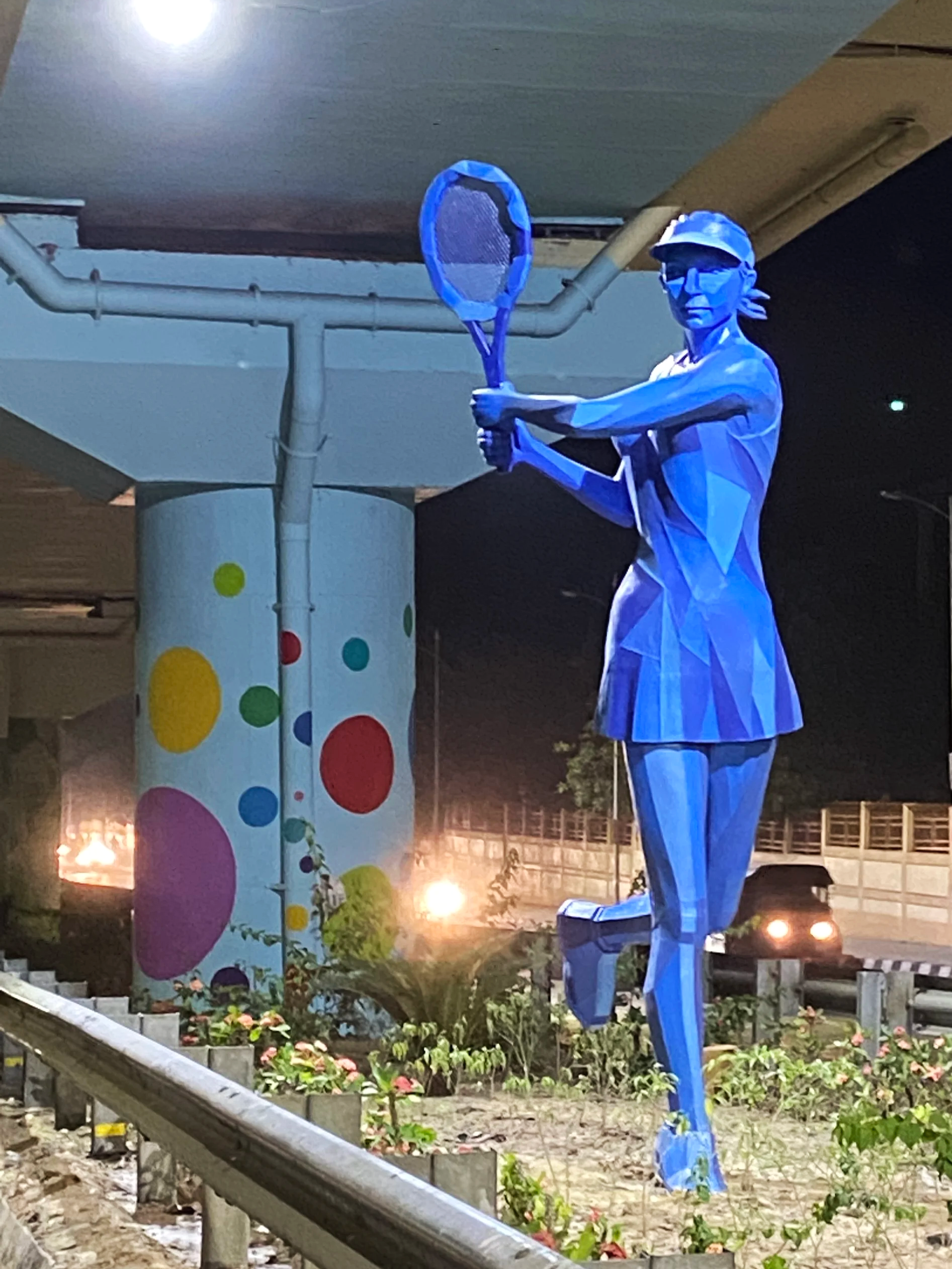
Under Liberty Flyover in Nagpur, the space beside the road was developed for sports and public activity. We created sculptures based on running, badminton, tennis and chess to connect the physical environment with the purpose of the space.
One of the most visible works is the large blue figure of a female tennis player. The sculpture is around 3.65 metres high and is designed to be seen from different directions.
The scale gives the player a strong presence. She is not standing still for a portrait. She is caught in action.
Nearby, the running composition uses four figures of different sizes to create a sense of forward movement. The badminton figures extend this energy across the space, while the chess installation introduces another kind of sport—one based on patience, observation and strategy. These sculptures do more than announce that sports facilities exist nearby.
They change the atmosphere.
A person passing beneath a flyover usually expects traffic, concrete columns and unused space. Encountering active human figures in that setting creates a different feeling. The space begins to suggest movement rather than neglect.
For a child, seeing a sport represented at such a large scale can make physical activity feel exciting and important. For someone who walks or exercises there regularly, the figures become familiar companions. For another person, they may provide a small push to imagine running, playing or participating.
The female tennis player also carries a quiet message. By giving a woman athlete such a prominent position in a public space, the sculpture makes her strength and confidence visible.
Not every person will explain the artwork in these words. That is not necessary.
If the space feels more active, if a child wants to pick up a racket, or if someone pauses and thinks about beginning to exercise, the sculpture has already started working.
Meaning matters more than decoration
One of the useful findings of the Berlin study was that participants did not need to consider the exhibition exceptionally beautiful for it to affect them.
What mattered was whether they found it meaningful, interesting and understandable.
This has direct implications for institutions commissioning public art.
A visually attractive object may receive attention for a few days. But if it has no relationship with the place, that attention may fade quickly.
A meaningful artwork continues to reveal itself.
At Chanda Fort, the meaning comes from regional history and Gond culture. At Gondia, it comes from wetlands, birds and the fragility of wildlife. Under Liberty Flyover, it comes from movement, health and participation.
These artworks are visually different because their places and purposes are different.
This is how it should be.
Public art should not be an object selected first and given a meaning afterwards. The meaning should help determine the object.
Public art gives institutions a recognisable face
Many institutional buildings are well designed and functional, yet one can still resemble another.
Public art introduces distinction.
A landmark sculpture at an entrance can become the image people associate with a campus. A mural can turn an ordinary concourse into a place travellers remember. An installation beneath a flyover can transform an overlooked area into a point of activity and pride.
Over time, these works become part of the institution’s identity.
People meet near them, photograph them and include them in celebrations. Students remember them after graduating. Visitors use them to describe the place. Images of the artworks appear in publications, news reports and social media without being planned as advertisements.
A logo identifies an institution on paper or on a screen.
Public art gives that identity a physical presence.
The investment must begin with understanding
A large artwork is not automatically an important artwork.
Scale can attract attention, but it cannot create meaning by itself. Expensive materials cannot compensate for an idea that has no relationship with the place.
Meaningful public art begins with questions.
What is distinctive about the site?
Who uses it?
What stories are already present?
What has been forgotten or overlooked?
What should a visitor understand or feel?
At Chanda Fort, the answer came from Gond culture, forests and the mining history of Chandrapur. At Gondia, it came from wetlands, birds and wildlife. Beneath Liberty Flyover, it came from the sports facilities and the possibility of turning an inactive urban space into an energetic one.
The form followed the purpose.
This is also why public art requires both artistic and technical thinking. A concept must be translated into a structure that can survive weather, public use and time. Its proportions must work from the actual viewing distance. Materials, foundations, internal supports, coatings and maintenance all influence whether the artwork will continue to serve the place years later.
The artistic idea attracts people.
Responsible execution allows it to remain.
What remains after the first impression?
Public art can attract attention on the day it is unveiled. But the more important question is what happens afterwards.
Does the work help people understand the institution or region better?
Does it give local communities a sense of recognition?
Does it reduce the emotional distance between people and a place?
Does it encourage curiosity, conversation or action?
Does it continue to hold meaning after being seen many times?
Great institutions think beyond decoration and beyond the opening ceremony. They understand that their buildings and public spaces will shape thousands of everyday experiences.
They also understand that identity is not created only through branding, advertisements and digital communication.
It is created through what people encounter, feel and remember.
At Chanda Fort, public art carries the history and culture of a region into a railway station. At Gondia, it asks people to look again at birds and wetlands that are slowly disappearing. Under Liberty Flyover, it brings movement and aspiration into a space once dominated by concrete and traffic.
These are very different projects, but their purpose is connected.
Each one helps an institution say something meaningful through the space it occupies.
That is why public art is not an additional expense added after a building is complete.
When it is created with understanding, it becomes part of the institution itself.
— Lalit Vikamshi
Research referenced: C. Kühnapfel, M. Trupp, M. Pelowski and J. Fingerhut, “On the impact of public art: How engaging a pedestrian-level exhibition improves neighborhood connectedness and well-being,” Wellbeing, Space and Society, 2025.