
Public Art Is How Institutions Speak Without Words
Some artworks are made to be seen. Some are made to be photographed.
But the most meaningful public artworks do something more.
They make people stop for a moment and think. Not always loudly. Not always immediately. Sometimes quietly — while passing through a station, walking inside a campus, waiting under a flyover, or looking at a wall they have seen every day.
That is where our work begins.
Not with the material. Not with the size. Not even with the sketch. It begins with a simple but difficult question:
What should this place make people understand?
When Indian Railways asks for artworks at a station, the requirement may sound straightforward. A sculpture. A mural. A beautified wall. A landmark element. But a railway station is never just a building. It is a public doorway into a region. Thousands of people pass through it — some local, some visiting for the first time, some only waiting for a few minutes.
In that short time, what can the station say?
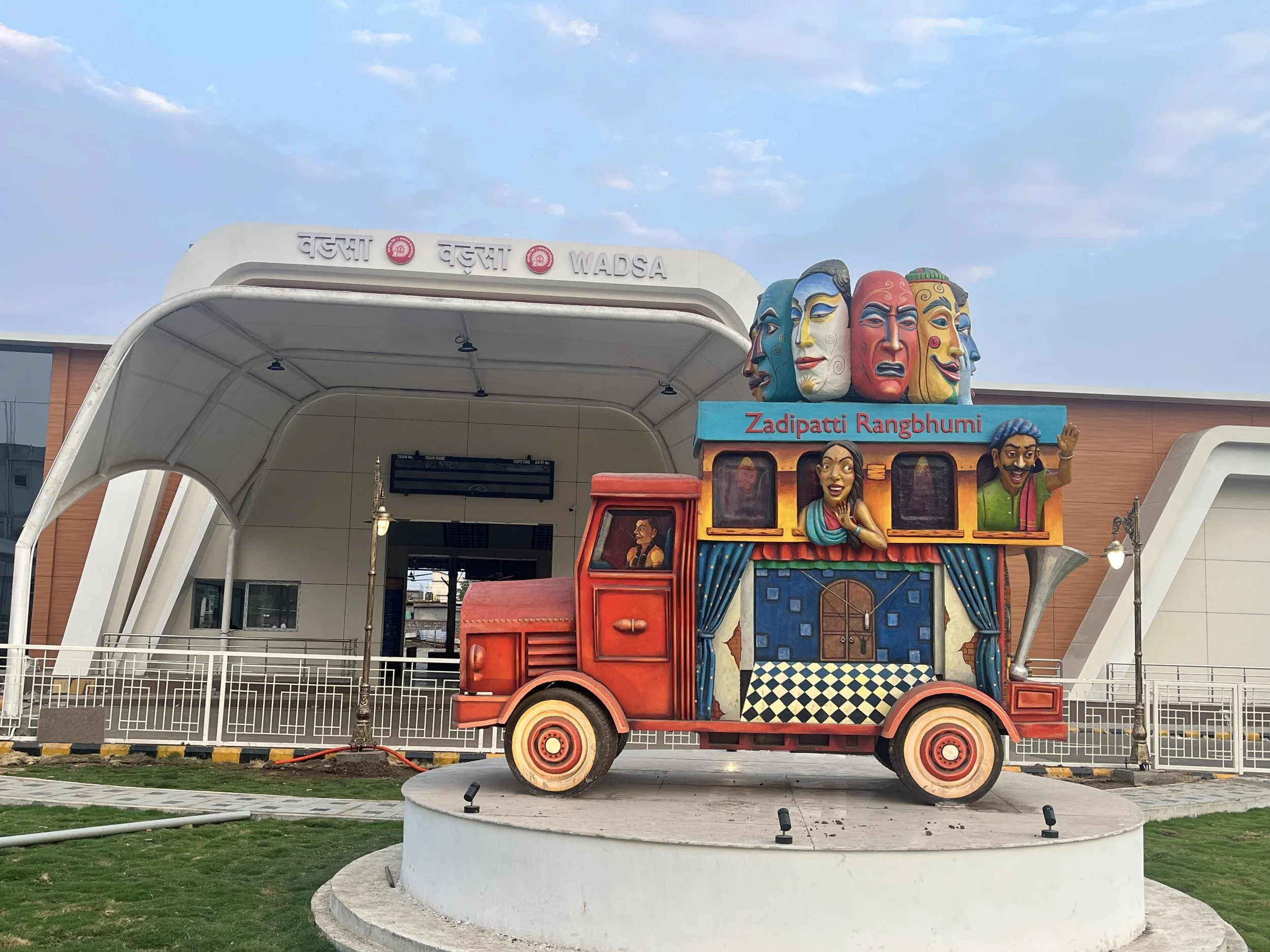
At Wadsa Railway Station, the answer came through Zadipatti Rangbhoomi, a local folk theatre tradition of the region. The sculpture was not created only to decorate the station. It was created so that a local performing art, often known deeply by the community but not always visible in mainstream spaces, could stand in a public institution.
For many local people, the response was not only, “This is a nice sculpture.” The deeper response was, “Our culture has been recognised.”
That difference matters.
At Gondia Railway Station, the bird sculptures carried another kind of meaning. Gondia has a strong association with wetlands, birds and local ecology. When people saw the sculptures, many did not speak first about the material or fabrication. They spoke about the birds themselves — how they had seen them earlier, how some had become less visible, and why such natural identity matters.
The sculpture had done its work. It had started a conversation beyond itself. This is the point where public art moves beyond beautification. It begins to carry memory, identity and awareness.
A similar question shaped the Sadar Flyover beautification work in Nagpur. A flyover is not a gallery. People do not go there to look at art. They pass through it in traffic, on the way to work, school, shopping, meetings and daily life. So the artwork had to enter the city’s movement without feeling forced. The site was not treated as one long surface to be painted. It was understood as a changing urban stretch with different people, different speeds and different moods.
Some areas could speak about sports and fitness. Some could introduce eminent personalities of Nagpur. Some could bring science, ISRO, space and aspiration into an everyday road experience. Some could create moments of curiosity for children. Some could simply make a hard traffic space feel more alive. The purpose was not to make the flyover colourful.
The purpose was to make an unexpected place carry meaning. A person may not stop there for long. But even a passing glance can leave behind a memory — a face, a figure, a word, a colour, a symbol, a question. That is enough for public art to begin working.
Inside an institution, the responsibility becomes even more layered.
At IIM Nagpur, the artworks were not created only as campus beautification. A management institute carries ideas every day — leadership, focus, strategy, ethics, change, communication, innovation, teamwork and self-belief.
The challenge was not to write these words on walls. The challenge was to make students experience them. At the entrance, Arjuna’s Vision becomes more than a figure with a bow. It becomes a symbol of focus — the ability to see the target when everything else is noise.
One of the most interesting works at IIM Nagpur is the shadow installation. At first, it appears as a visual design on the building. Then, as the sun moves, words from change management begin to form through shadow. They appear slowly. Alignment. Ethics. Strategy. Communication. Sustainability. Other ideas emerge with time and light.
By evening, they begin to disappear again. This is not only a design effect. It is a way of saying that ideas also appear when conditions are right. Clarity is not always static. It changes with time, light, position and attention. For a management campus, that becomes a quiet but powerful metaphor.
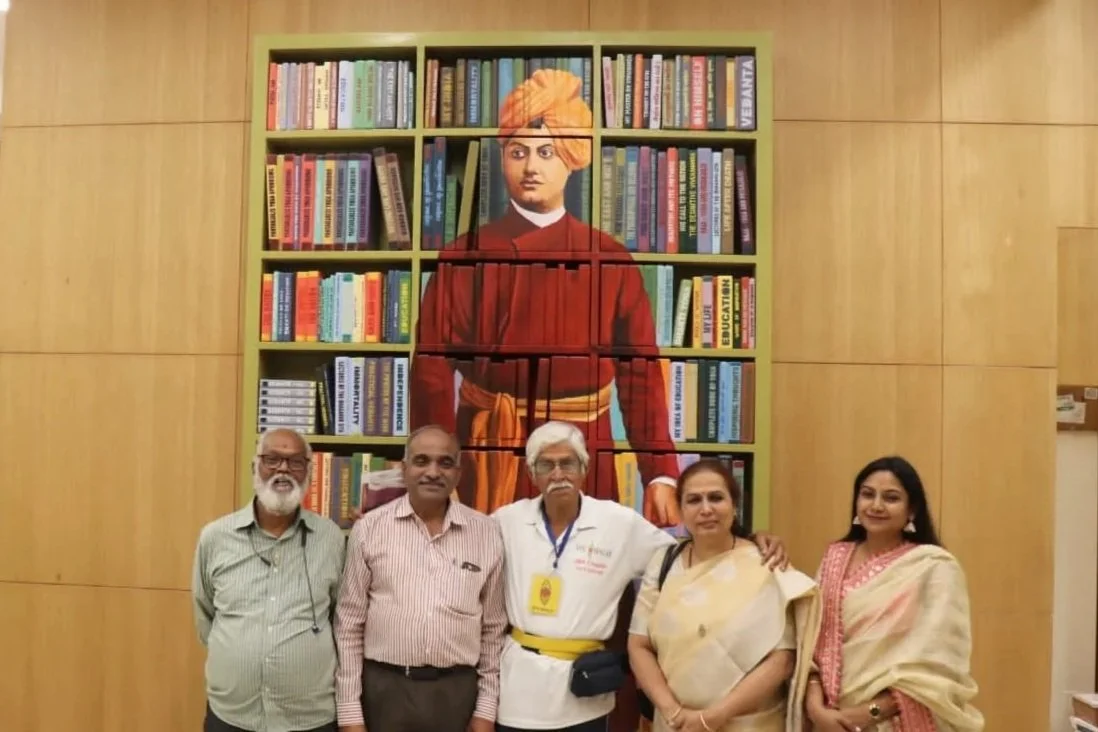
The Vivekananda mural in the library works differently. We know Vivekananda largely through his words, his books, his speeches and the ideas he left behind. So instead of making a normal portrait, the image was formed through bookshelves and books. His presence comes out of reading itself. That decision is important. Because the medium and the message become one. The student does not only see Vivekananda in a library. The student sees him emerging from books — from knowledge, study and reflection. That is the kind of idea public art can carry when it is not treated as decoration.
Every project begins with research, but research alone is not the final answer. Research opens many possible directions. The harder work is selection. What is relevant to this place? What will people understand without a long explanation? What idea has enough depth to remain meaningful after the first impression? What should be avoided? What belongs here and what does not? This judgement is central to public art.
The right idea is not always the biggest idea. It is not always the most decorative idea. It is not always the most technically complex idea. The right idea is the one that can belong to the place and stay in people’s memory. That is why public art requires both thinking and making.
A concept without execution remains only an idea. Execution without meaning becomes only an object.
The real work lies between the two.
At LHV, our process moves through research, interpretation, design and execution. We study the place, the people, the institution and the response the artwork should create. Then we choose the form — sculpture, mural, installation, relief, light, movement, material or a combination of them — that can carry the idea best.
Because a public artwork is not only something placed in space. It becomes part of how people understand that space. A railway station can tell the story of a region. A flyover can become part of a city’s public memory. A campus can quietly repeat its values to students every day. A sculpture can become recognition. A mural can become identity. An installation can become a conversation. That is why meaningful public art does not begin with decoration.
It begins with understanding. And when the understanding is clear, the artwork does not need to shout.
It stays.
- Lalit Vikamshi
Planning a public art, campus landmark, railway station artwork or institutional installation?
LHV helps translate ideas, culture and objectives into meaningful physical experiences.